Why Traditional Project Management Tools Help Projects Fail
Superthread founder David explores the three critical flaws in modern project management software: visibility gaps, clunky data input, and broken search.

Why Projects Fail (and How Your Tools Are Helping)
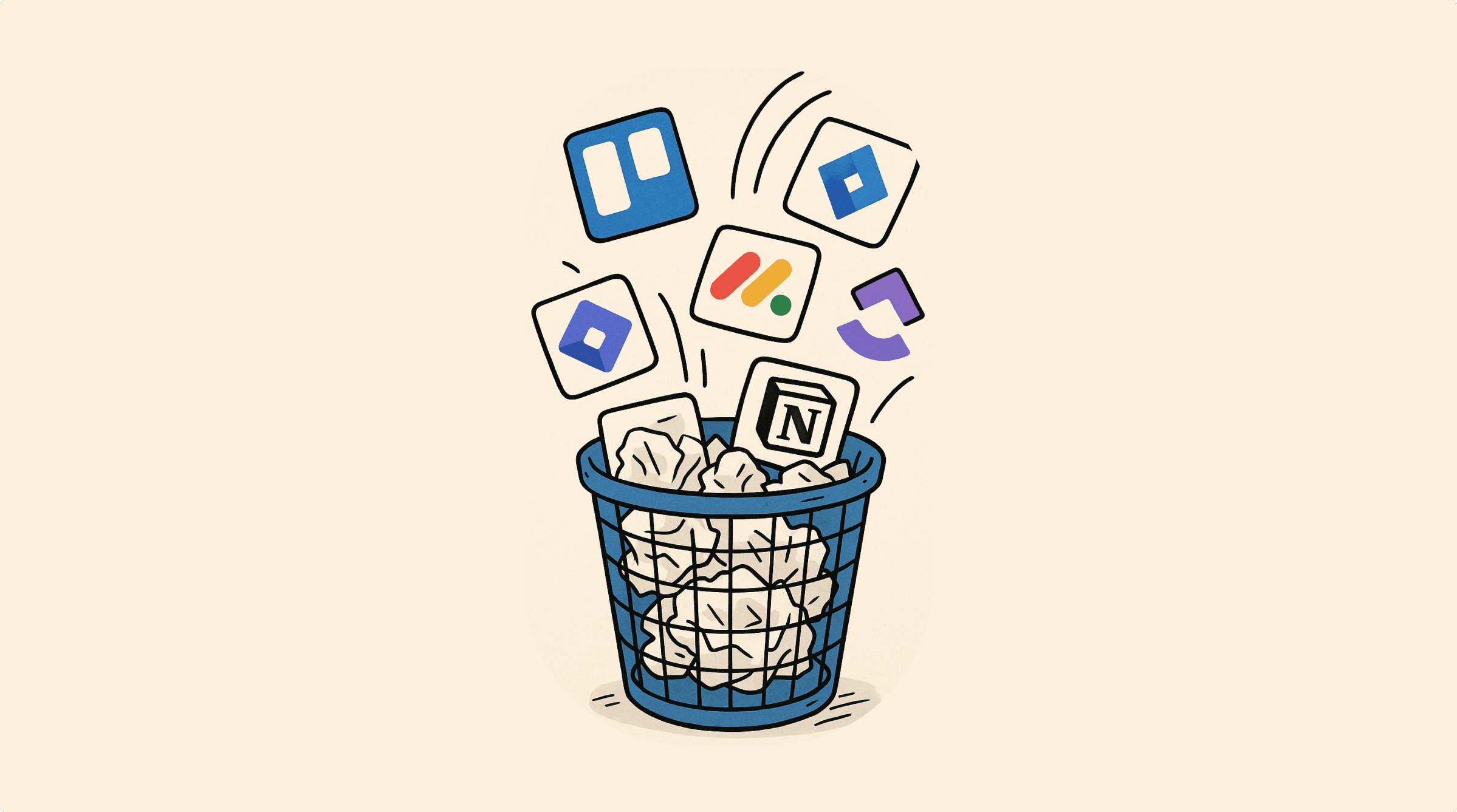
In my experience, projects don’t just fail because of bad planning. They fail because the very tools we use to manage them are fundamentally broken. In fact, most project management software actually helps projects fail by creating friction where there should be flow.
Here are the three primary reasons why current project management tools are failing teams and what we are doing differently.
1. The ‘Zoom Level’ Problem: Broken Visibility
In any organization, you have three distinct roles: individual contributors (programmers, designers), team leads (project managers), and C-level executives (CEOs, CFOs).
The problem is that they all need to see different things:
- The CEO doesn’t want to see individual tasks; they need the high-level roadmap and the health of the business.
- The Contributor doesn’t need the CFO’s view; they need to know what to build next.
Existing tools are terrible at providing the right level of visibility to all these different ‘zoom levels.’ None of them effectively bridges the gap between deep execution and high-level observability.
2. The Input Friction: Clunky Data Entry
A tool is only as good as the data inside it. If you don’t have the information input, you can’t make data-driven decisions.
Most project management tools are incredibly clunky. Just opening them up is a pain. It’s difficult to know where to enter information or where the ‘source of truth’ actually lives. Because the input process is so taxing, people stop doing it. When the data dries up, the tool becomes useless, and the project loses its direction.
3. The Scaling Tax: Garbage In, Garbage Out Search
Search is where most tools completely fall apart as a company scales. Sure, the search engines ‘work’, they index a task, and if you type a keyword, it appears.
But as soon as a team starts growing, you end up with too much ‘stuff.’ A simple indexing engine starts returning garbage. You find ten versions of the same task, outdated docs, and irrelevant threads. In a world of large language models (LLMs) and AI, this should be a solved problem. Yet, the current SaaS landscape is still stuck with primitive search interfaces that fail the moment you actually need to find something relevant.
The Superthread Approach
At Superthread, we are focusing on solving these three pillars:
- High-Fidelity Visibility: Ensuring observability is seamless across every level of the organization.
- Zero-Friction Input: Making it incredibly easy for anyone to enter data without fighting the interface.
- Contextual Search: Building a system where people can actually find what they are looking for, even at scale.
We are moving away from the ‘classical’ type of software that has stayed stagnant for too long. It’s time for project management to actually support the project, rather than getting in its way.
Ready to see project management that actually works?
Stop fighting your software. Experience the speed, visibility, and search power of a modern, anti-bloat workspace. Sign up for Superthread for free
Further Reading & Resources
- The Anti-Bloat Philosophy: Why we refuse to build slow, enterprise-cluttered software.
- Superthread vs. Legacy PM Tools: Why teams are switching for better visibility.
- Building for Speed: How we optimized Superthread for instant data entry.