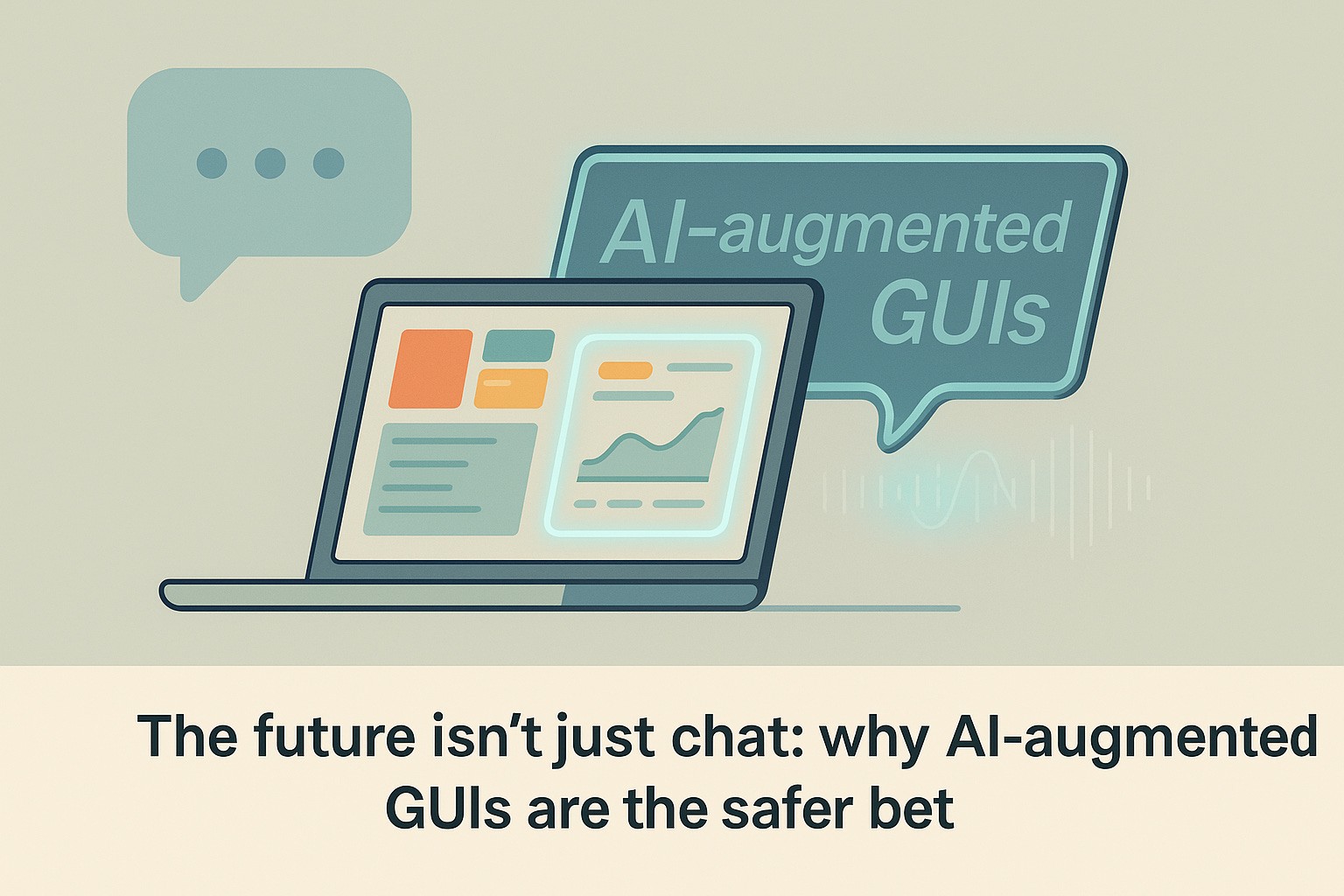
The Future Isn’t Just Chat
Why AI-augmented GUIs are the safer bet
We’ve spent the last 18 months pretending that chat is the final interface.
It’s not.
Chatbots exploded because they were the fastest way to showcase raw model power. You could ask anything, get a fluent response, and feel the magic instantly. But as we settle into the reality of AI at work, the cracks are starting to show, especially when chat becomes the only way to interact with intelligence.
The real challenge? Pure chat struggles with structure, speed, and signal clarity — three things your brain craves when dealing with complex workflows. Whether you’re managing a roadmap, chasing dependencies, or skimming notes from a meeting, reading a block of text from a chatbot just doesn’t cut it.
Apple’s own research sets the tone
Apple’s updated Foundation Models paper explains that the on-device 3-billion-parameter model “excels at summarisation, entity extraction, text understanding, refinement, short dialogue, generating creative content, and more. It is not designed to be a chatbot for general world knowledge.”
The message is clear. Apple wants intelligence to surface inside existing views instead of sitting in a separate conversation window.
Intelligence belongs inside the interface you already use
In the press release that introduced Apple Intelligence, Apple highlighted that the system is “deeply integrated into iOS 18, iPadOS 18 and macOS Sequoia”, where it draws on personal context and takes action across apps. There is no mention of a new standalone chat app; the primary interface stays visual and interactive while AI fills in the gaps.
Why pure chat still struggles in everyday work
- Linear scroll versus spatial clarity – A roadmap or dashboard lets you gauge status at a glance, whereas a chat log forces you to hunt for information.
- Open-plan etiquette – I am a big voice fan, yet in offices most people type because speaking aloud feels intrusive and reveals private queries.
- Cognitive load – A single prompt can return a dense block of prose. A visual layer can show the same insight with coloured badges, small sparklines or hover cards that you scan in seconds.
What comes next?
Probably AI-first glanceability
No-one has the final pattern yet. My sense is that interfaces will stay quick, clean and click-friendly, with AI quietly filling in details when you need them. Think of timelines that auto-flag silent blockers or boards that highlight at-risk work without waiting for you to ask. The specifics will evolve; contextual augmentation is likely to stay.
Voice still shines, just not everywhere
Voice transcription coupled with AI-generated notes is close to magic when you are capturing meetings. Inside Superthread I record, transcribe and let the model summarise calls; the note then appears in the timeline where I can see how it fits with everything else. Apple’s own Notes and Phone apps support the same flow: record, receive a transcript and view an instant summary in place.
Yet once I am back at my desk I prefer to skim those summaries rather than listen to a bot read them aloud.
The takeaway
Chat is brilliant for open-ended ideation and hands-free moments. Dense, state-heavy tasks such as project management require something different.
Chat for capture; GUI for clarity; AI as the invisible glue.
Fast, AI-augmented interfaces — Superthread included — are more likely to shape the next wave of productivity than one-size-fits-all chat windows. The coming UX leap will not sound like a conversation; it will look like the dashboards you already trust, only sharper, lighter and far smarter.